
40+ Networking Event Ideas: Fun, Business, Corporate and Virtual Formats

Networking event ideas range from structured referral rounds to relaxed socials and virtual breakout sessions. This guide covers more than 40 networking event ideas for small businesses, corporate teams, young professionals and online audiences, plus how to choose a format, plan the event step by step and measure whether it worked.
What Is a Networking Event?
A networking event is a gathering designed to help people meet, build professional relationships and find opportunities such as clients, partners, hires or advice. Networking events are hosted by chambers of commerce, referral groups, industry associations, companies, coworking spaces and community organizations. A networking event can be a 60-minute breakfast meeting, an evening mixer, a half-day workshop or a virtual session with breakout rooms. Attending rather than hosting? See how to network at an event.
Networking events differ from conferences and trade shows because relationship building is the main purpose, not a side benefit. The best networking event ideas give attendees a reason to talk, a structure that removes awkwardness and an easy next step after the event ends.
What Makes a Networking Event Idea Work?
A networking event idea works when it matches the audience and makes conversation easier. Strong events share five ingredients:
- Clear audience: attendees who can help each other, such as businesses that serve the same customers.
- Built-in structure: an activity, prompt or format that starts conversations without pressure.
- Shared reason to talk: a topic, game, speaker or challenge everyone experiences together.
- Right size and length: enough people for variety, short enough to keep energy high.
- Easy follow-up: an attendee list, a next event date or a simple way to reconnect.
A useful decision rule: if most guests are strangers, add more structure; if most guests already know each other, add more open time. Structure helps first-timers, while regulars value free conversation.
What Are the Best Icebreaker Activities for Networking Events?
Icebreaker activities give strangers a low-pressure first topic. The table compares icebreakers by group size and time needed.
| Icebreaker | How it works | Group size | Time |
|---|---|---|---|
| Two truths and a business lie | Each person shares three facts; others guess the false one | 4 to 8 | 10 min |
| Name-tag prompt | Tags say “Ask me about…” to spark questions | Any | No extra time |
| Common ground hunt | Pairs find three things they share | Any | 5 min |
| Referral wish | Each person names one company they want to meet | 8 to 30 | 10 to 15 min |
| One-word intro | Describe your business in one word, then explain | 8 to 20 | 10 min |
| Speed rounds | Timed pairs rotate every few minutes | 10 to 60 | 20 to 40 min |
| Table topics | A question card at each table guides discussion | Tables of 4 to 8 | 15 min |
| Human bingo | Find people who match squares such as “hired someone this year” | 20+ | 15 min |
What Are Fun Networking Event Ideas?
Fun networking event ideas build relationships through a shared activity, which takes pressure off conversation:
- Trivia night with mixed teams of strangers.
- Cooking or mixology class in small groups.
- Bowling, mini golf or axe throwing socials.
- Brewery or winery tour with a guided tasting.
- Game night with board games at each table.
- Sports watch party at a local grill.
- Easy group hike or walking meeting.
- Charity build or volunteer morning.
- Holiday party with a small gift exchange.
- Business card raffle for a prize from a local member business.
What Are Good Business Networking Event Ideas for Small Businesses?
Business networking event ideas for small businesses focus on referrals, learning and visibility. These formats work well for local owners and professionals:
- Referral round: each attendee names the type of client they want to meet next.
- Power partner tables: seat related industries together, such as real estate, lending, insurance and home services.
- Member spotlight: two businesses each present for five minutes with time for questions.
- Lunch and learn: a member teaches a practical topic while everyone eats.
- Ask-the-expert tables: accountants, attorneys and IT pros answer quick questions.
- Business showcase: tabletop displays where members demonstrate products.
- Breakfast roundtable: one business challenge discussed per table.
- Pitch practice: pairs refine their 30-second introductions and give feedback.
These formats work because they teach attendees what each business does and who it serves, which is what people need to know before they can refer each other. See how power partners pass referrals.
How do you run a referral round?
A referral round takes about one minute per person. Each attendee states their name, business and one specific request, such as “an introduction to a property manager in Littleton.” The host writes requests on a board, and attendees note any they can help with. At the end, give two minutes for people to swap contact details with the people they can help. Specific requests produce far more introductions than general ones.
How do you run power partner tables?
Power partner tables group businesses that serve the same customer from different angles. Label tables by customer journey, such as “buying a home,” “starting a business” or “planning retirement.” Ask each table to map the moments when their shared customer needs help and who serves each moment. Attendees leave knowing exactly when to refer each other, which turns a single event into lasting partnerships.
How do you run a member spotlight?
A member spotlight gives one or two businesses five to ten minutes to explain who they serve, what a great referral looks like and one recent client story. Ask the presenter to end with a specific request. Rotate spotlights so every member presents over time; members who have presented usually receive better referrals because the group finally understands their business.
What Are Corporate Networking Event Ideas?
Corporate networking event ideas connect employees across departments or with clients and partners:
- Cross-department coffee roulette: random pairs meet for 20 minutes.
- Client appreciation reception with short customer stories.
- Industry panel followed by a structured reception.
- Mentoring circles that pair senior and junior staff.
- Innovation workshop in mixed teams.
- Community service day with partner companies.
What Are Networking Event Ideas for Young Professionals?
- Career story night: three local owners share how they started.
- Skill swap: attendees teach each other a ten-minute skill.
- Patio or rooftop social after work.
- Fitness class followed by coffee or smoothies.
- Startup pitch night with audience voting.
What Are Virtual and Hybrid Networking Event Ideas?
Virtual networking event ideas work when they recreate small-group conversation online. Large webinars with chat boxes rarely build relationships, so plan breakout time:
- Breakout speed networking in three-minute rounds.
- Virtual coffee chats with random pairing.
- Online trivia in small teams.
- Virtual lunch and learn with meal vouchers mailed in advance.
- Show-and-tell of one favorite business tool.
- Hybrid table hosts: an in-person host brings remote guests into table conversations by video.
What Are Industry-Specific Networking Event Ideas?
Industry-specific networking event ideas attract people who share customers or challenges, which makes conversations more useful from the first minute:
| Industry | Event idea | Why it works |
|---|---|---|
| Home services and contractors | Project showcase breakfast with before-and-after photos | Trades refer each other on nearly every job |
| Real estate | Homebuyer journey roundtable with lenders, inspectors and insurers | Everyone serves the same buyer at different moments |
| Professional services | Ask-the-expert lunch with accountants, attorneys and advisors | Owners bring real questions and meet trusted advisors |
| Health and wellness | Wellness open house with short demos | Clients often need several complementary practitioners |
| Creative and marketing | Portfolio night with five-minute showcases | Visual work is easier to remember than descriptions |
Specialty groups follow the same logic. A contractors-only group, for example, lets trades who work on the same projects build trust quickly, while a mixed-industry group gives each member a wider range of referral sources.
How Do Recurring Networking Groups Keep Events Fresh?
Recurring networking groups keep events fresh by rotating formats while keeping the core routine the same. A group that meets every other week can rotate a different spotlight presenter each meeting, add a themed referral round once a month, invite a guest speaker each quarter and hold a social or charity event a few times a year. Members value the predictable rhythm, and the rotating element gives regulars a reason to invite guests and keeps first-time visitors engaged. Ask members every few months which formats produced the most useful conversations and drop the ones that did not.
Which Networking Activities Suit Large Groups and Small Groups?
| Group size | Best activities | Watch out for |
|---|---|---|
| Under 15 | Round-robin introductions, roundtable discussion, one-to-one pairing | Dominant talkers |
| 15 to 40 | Referral round, table topics, speed rounds, member spotlight | Long introductions |
| 40 to 100 | Speed networking rows, human bingo, hosted tables | Noise and crowding |
| 100+ | Interest-based zones, app-based matching, hosted connectors | People sticking with friends |
What Are Good Networking Event Themes by Season?
Seasonal networking event themes give recurring groups fresh reasons to attend:
| Season | Theme idea |
|---|---|
| Winter | Goal-setting breakfast and planning workshop |
| Spring | Spring clean your business: processes, finances and marketing refresh |
| Summer | Patio mixer, outdoor games or a family-friendly picnic |
| Fall | Customer appreciation month and gratitude-themed referral round |
| Holidays | Charity drive mixer with a donation collection |
How Do You Choose the Right Networking Event Format?
Choose the networking event format by starting with the goal. The table gives a simple decision rule.
| If your goal is… | Choose this format |
|---|---|
| Steady business referrals | Recurring referral meeting with introductions and referral rounds |
| Meeting many new people | Mixer with an icebreaker or speed rounds |
| Building credibility | Lunch and learn or panel |
| Connecting a room of strangers | Speed networking or table topics |
| Strengthening existing relationships | Social event or volunteer day |
| Reaching people in several cities | Virtual breakout networking |
Recurring groups benefit from mixing formats. A referral group that meets every other week can add a monthly social and an occasional educational session so members see each other in different settings.
How Do You Plan a Networking Event Step by Step?
1. Define the audience and goal
Write one sentence describing who the event is for and what success looks like, such as “local service businesses meeting two new referral partners each.”
2. Pick the format, venue and date
Choose a venue with room to move, moderate noise and easy parking. Breakfast and lunch slots suit busy owners; early evening suits social events.
3. Set the budget
Budget for venue, food, name tags, any activity supplies and promotion. Sponsors or co-hosting partners can share costs in exchange for visibility.
4. Promote the event
Invite through email, social media, partner organizations and personal invitations. Personal invitations from members usually bring the best-fit guests.
5. Write a run-of-show
| Time | Segment |
|---|---|
| 0:00 | Arrival, name tags, open networking |
| 0:15 | Welcome and purpose of the event |
| 0:20 | Structured activity or introductions |
| 0:50 | Open networking |
| 1:15 | Closing, thanks and next event date |
6. Follow up
Send attendees a thank-you message within a day with the next event date and, with permission, the attendee list. Follow-up turns one event into an ongoing community.
What Are Networking Event Ideas on a Small Budget?
Networking event ideas on a small budget rely on partnerships and simple formats rather than expensive venues. Low-cost options include:
- Host at a member’s business: an office, showroom or shop after hours.
- Pay-your-own breakfast or lunch: a restaurant private room where guests order individually.
- Co-host with a partner group: share promotion and costs.
- Sponsor-supported refreshments: a local business covers coffee in exchange for a short welcome.
- Park or trail meetups: free venues for walking meetings in good weather.
- Library or coworking community rooms: often free or inexpensive for community events.
How Do You Get People to Attend a Networking Event?
Getting people to attend a networking event depends on a clear reason to come and personal invitations. State who will be there and what attendees will gain, such as “meet 20 local home-service businesses.” Ask regular members to each invite one guest, because personal invitations convert far better than social posts. Send a reminder the day before with parking details, and keep a consistent day and time for recurring events so attendance becomes a habit.
What Mistakes Should Networking Event Hosts Avoid?
- No structure: guests cluster with people they already know.
- Long speeches: attendees came to talk, not to listen for 40 minutes.
- Too loud a venue: conversations become impossible.
- No name tags: people avoid introducing themselves when they forget names.
- Ignoring first-timers: new guests leave early if nobody welcomes them.
- No follow-up: connections fade without a reminder or next date.
A host who greets every guest, introduces newcomers to two people and keeps the schedule on time solves most of these problems. See networking tips for attendees.
How Do You Measure a Networking Event’s Success?
Measure a networking event by what happens after it, not only by attendance. Useful indicators include:
- Attendance: registrations versus actual arrivals.
- New connections: how many attendees met someone new and useful.
- Follow-ups: one-to-one meetings booked within two weeks.
- Referrals: introductions or business that resulted from the event.
- Return rate: how many first-time guests come back.
A short three-question survey after the event, asking what worked, what did not and whom they met, gives enough feedback to improve the next one.
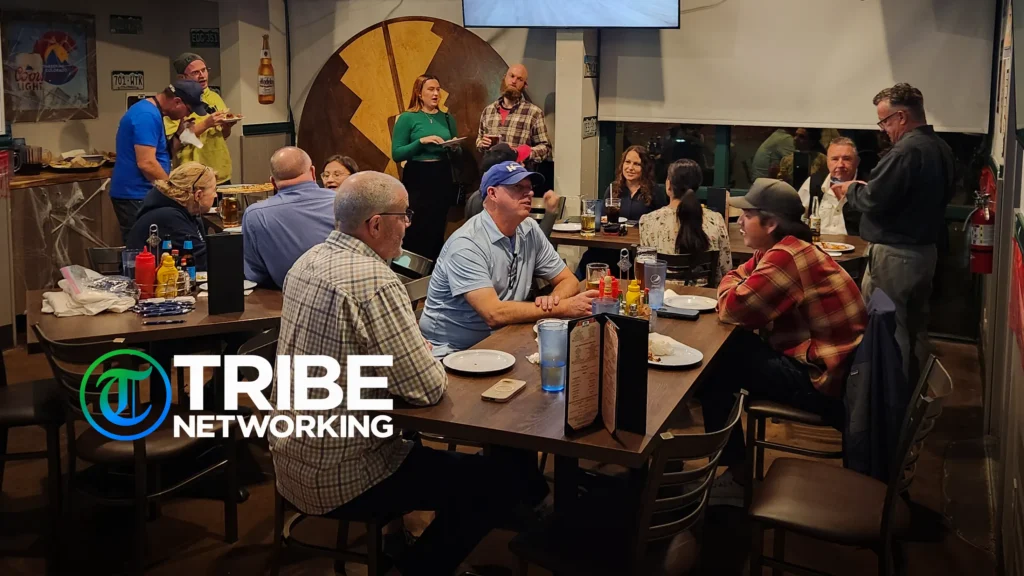
What Do Networking Events Look Like at Tribe Networking in Denver?
Tribe Networking combines three event types across the Denver metro, the foothills and Colorado Springs. Area groups hold structured referral meetings every other week, with introductions and time to pass referrals. Monthly Mingles add a relaxed social setting where members and guests from different groups meet. Lunch & Learns cover practical topics such as cybersecurity, succession planning and social media for local businesses. Guests can attend three meetings free. See the Monthly Mingle, Lunch & Learn events or the full event calendar.
Frequently Asked Questions
How do you make a networking event fun?
Make a networking event fun by adding a shared activity, such as trivia, a game, a tasting or a hands-on workshop, plus a simple icebreaker. Shared experiences give people something to talk about besides work, which makes conversations feel natural.
How long should a networking event last?
A networking event usually lasts 60 minutes to two hours. Breakfast and lunch formats often run 60 to 90 minutes, while evening mixers may run two hours. Shorter events keep energy high and respect busy schedules.
How many people should attend a networking event?
A productive networking event can work with ten people or several hundred. Smaller events allow deeper conversations and suit referral groups, while larger events need more structure, such as speed rounds, hosted tables or interest-based zones.
What is the best day for a networking event?
Tuesday through Thursday are popular days for business networking events because they avoid busy Mondays and Friday wind-downs. Breakfast or lunch times suit owners with full schedules, while early evening suits social formats.
Practice With Your Tribe
Experience a well-run networking meeting. Visit Tribe Networking. Guests are welcome and your first three visits are free.